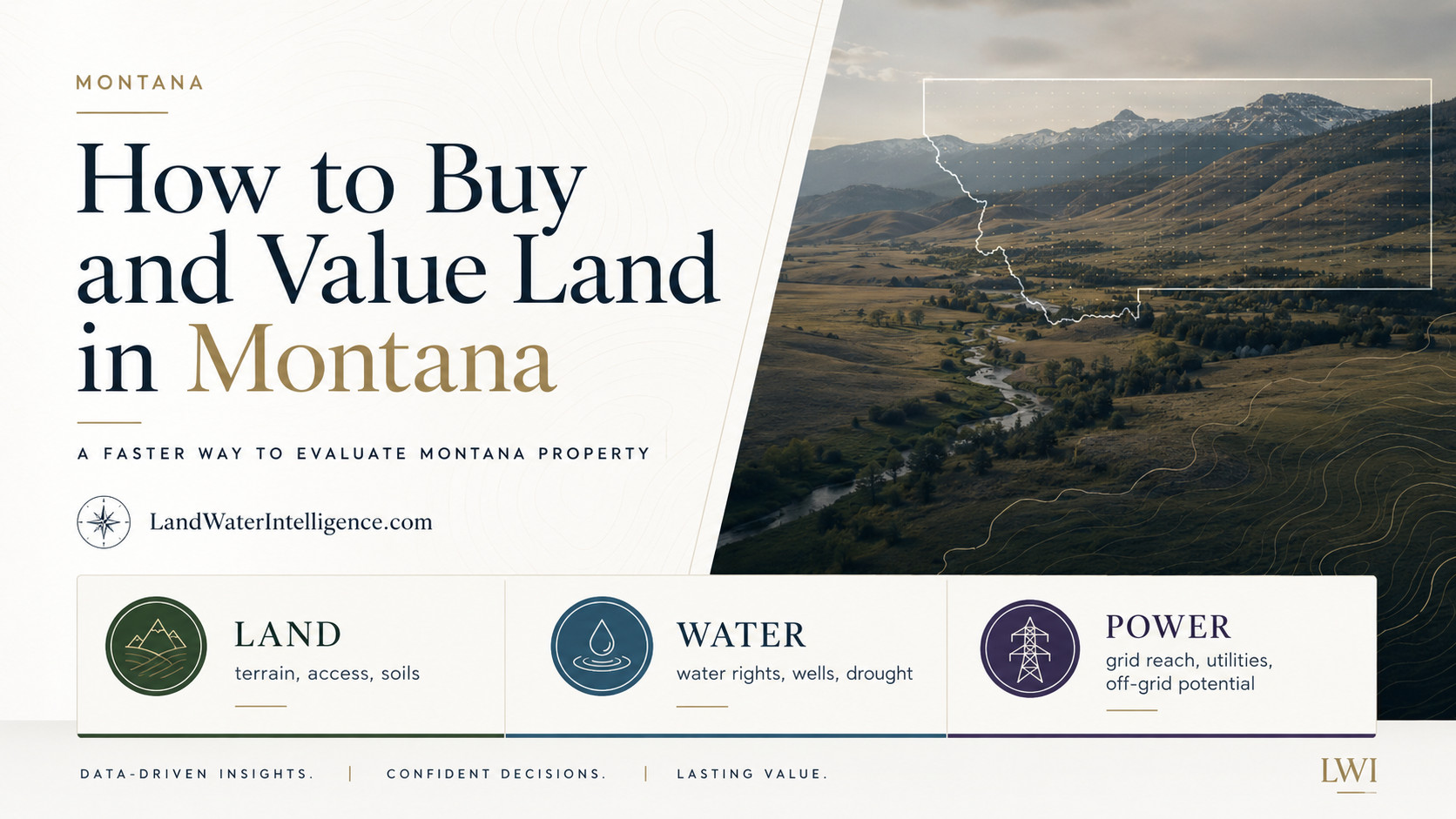
Montana land can look simple on a listing page: acreage, price, views, and a few photos. The real value usually comes from deeper questions: what land is actually usable, what water is legally and physically reliable, and what power or off-grid infrastructure will really cost.
Land
Water rights
Wells
Septic
Grid power
Wildfire risk
Land Water Intelligence organizes Montana property questions into land, water, and power signals.
Quick answer: how should you buy and value Montana land?
Value Montana land by estimating the usable land, confirming the water reality, and pricing the power and infrastructure gap. A cheaper parcel can become expensive if it has weak access, steep terrain, no confirmed water rights, poor well prospects, septic limitations, wildfire exposure, floodplain constraints, or a long utility extension.
Confirm the exact parcel, boundaries, legal access, road maintenance, zoning, covenants, easements, and buildable area.
Verify water rights, well records, surface water, irrigation, drought exposure, floodplain status, and septic feasibility.
Estimate electric service, gas, broadband, driveway, trenching, off-grid energy, emergency access, and long-term maintenance costs.
Adjust comparable sales by the cost, risk, and time needed to make the property usable for your intended purpose.
The LWI framework
Why Montana land value should be analyzed through land, water, and power
Most Montana land buyers start with location, acreage, and scenery. Those matter, but they are only the visible layer. The strongest parcels usually combine good physical usability, reliable water, practical access, realistic utility service, and manageable regulatory or natural-hazard risk.
Land Water Intelligence is being built to make these checks faster and more consistent for Montana properties. The goal is not to replace a surveyor, water-rights attorney, appraiser, engineer, county planner, or utility representative. The goal is to surface the right parcel-level questions quickly so buyers can understand risk before they commit capital.
A Montana parcel should be valued as a system: the land you can use, the water you can rely on, and the power or infrastructure needed to make the use practical.Pillar 1: Land
Land: what is actually usable?
The first mistake is valuing Montana land by total acreage instead of usable acreage. A 40-acre parcel with steep slope, poor access, wetlands, wildfire exposure, or no practical homesite may be less valuable than a smaller parcel with a confirmed build site and year-round access.
Important land checks
Legal access: verify recorded access, easements, road rights, gates, and whether access is public, private, seasonal, or disputed.
Topography: compare slope, elevation, aspect, snow exposure, drainage, and the actual area that can support a house, barn, shop, corral, or road.
Soils and wetlands: investigate soil limitations, potential wetlands, riparian areas, and erosion risk before assuming a site can be built or improved.
County rules: check zoning, subdivision restrictions, setbacks, floodplain rules, covenants, conservation easements, and whether the intended use is allowed.
Wildfire: look at vegetation, slope, road access, defensible-space potential, nearby suppression resources, and insurance availability.
Pillar 2: Water
Water: what can you legally and reliably use?
Water can be the biggest hidden value driver in Montana. A parcel with productive water rights, reliable wells, practical livestock water, or irrigation potential may command a premium. A parcel with uncertain water can carry serious use limitations.
Important water checks
Recorded water rights: verify owner, priority date, purpose, flow rate or volume, source, period of use, place of use, and whether records need updating.
Wells: review nearby well logs, depth, static water level, yield, pump records, age, and water quality testing.
Surface water: do not assume a creek, spring, ditch, pond, or river frontage creates the right to divert, pump, irrigate, or store water.
Irrigation and livestock: confirm whether irrigation rights, ditch shares, stock water, and delivery infrastructure match the use you are pricing.
Drought and snowpack: compare the watershed, drought history, seasonal flow, drainage, and long-term reliability.
Septic and sanitation: confirm that potable water and wastewater disposal can be approved for the intended residential or commercial use.
Pillar 3: Power
Power: what will it cost to make the parcel usable?
Power is often where raw land math changes fast. The listing may say “power nearby,” but nearby does not mean cheap, immediate, or sufficient. Distance, terrain, poles, easements, transformers, trenching, utility territory, and load requirements all matter.
Important power checks
Electric line proximity: measure the distance from existing distribution lines to the likely building site, not just the property line.
Utility estimate: request a service extension estimate before closing when power is not already at the build site.
Gas and broadband: determine whether gas and internet service exist or whether the property needs propane, satellite internet, fixed wireless, or fiber extension.
Off-grid potential: compare solar exposure, wind potential, backup generation, battery sizing, winter performance, and permitting.
Long-term use: a cabin, full-time residence, ranch operation, EV charging, shop, irrigation pump, or energy-adjacent use may require very different capacity.
Montana value drivers
The biggest value drivers when comparing Montana land
The right valuation is not simply price per acre. A stronger comparison adjusts for location, legal access, usable terrain, water reliability, utility cost, risk, and the time required to turn raw land into the buyer's intended use.
1. Location and demand path
Proximity to towns, employment centers, ski areas, national forests, rivers, recreation corridors, hospitals, airports, and quality roads can change demand. So can the direction of growth from Bozeman, Missoula, Kalispell, Helena, Billings, Livingston, Whitefish, Big Sky, and other regional markets.
2. Usable acres, not total acres
Subtract land that is too steep, wet, flood-prone, restricted, inaccessible, or impractical for the buyer's plan. Then value the land based on what can actually support housing, grazing, farming, recreation, timber, or conservation use.
3. Water reliability
Water rights, well reliability, irrigation infrastructure, ditch delivery, stream adjacency, pond or spring context, drought sensitivity, and flood exposure can all affect use and resale value.
4. Build-readiness
A parcel with a feasible homesite, access, septic approval path, driveway plan, water source, and power estimate is usually easier to value than a parcel with unresolved due diligence.
5. Risk discounts
Wildfire risk, floodplain limits, poor road access, steep slopes, weak soils, recorded restrictions, shared access disputes, and unclear water records can reduce value or increase negotiation leverage.
6. Cost to make usable
Adjust the purchase price by the cost of survey work, driveway construction, well drilling, septic design, electric extension, trenching, propane, broadband, fencing, clearing, drainage, and engineering.
How LWI will help
How Land Water Intelligence will make Montana due diligence faster
Land Water Intelligence is being built to give buyers a parcel-level view of the three layers that matter most: land, water, and power. Instead of opening separate county maps, water-right systems, well logs, flood maps, wildfire tools, utility pages, and planning documents, LWI will organize the most important signals into a faster property decision workflow.
Land layer
Parcel boundaries, slope, elevation, access context, terrain, floodplain, wetlands, county constraints, wildfire exposure, and buildability prompts.
Water layer
Water rights research prompts, well context, surface-water adjacency, drought and snowpack indicators, watershed context, irrigation questions, and septic feasibility reminders.
Power layer
Grid proximity, utility service questions, gas and broadband prompts, substation or transmission context where relevant, and off-grid renewable potential.
Important: LWI is informational and due-diligence oriented. Buyers should still verify property-specific facts with qualified professionals, public records, title documents, county officials, Montana DNRC, Montana DEQ, utility providers, surveyors, water-rights professionals, appraisers, and attorneys.
SEO FAQ
Common Montana land buying questions
How do I buy land in Montana?
Start with the intended use: home, cabin, ranch, hunting, recreation, conservation, investment, subdivision, or energy-adjacent use. Then verify legal access, parcel boundaries, title, zoning, covenants, water rights, well or water source, septic feasibility, power, driveway access, floodplain status, wildfire exposure, and total improvement cost before closing.
What should I check before buying Montana land?
Check legal access, survey and boundaries, zoning, easements, covenants, buildable area, slope, soils, floodplain, wetlands, wildfire risk, water rights, well records, septic approval path, electric service, internet, road maintenance, snow access, tax classification, and whether the property can actually support your intended use.
What makes Montana land valuable?
High-value Montana land usually has a strong location, usable acreage, reliable access, practical terrain, confirmed water rights or water source, feasible septic, realistic power, attractive views or recreation value, manageable wildfire risk, and clear regulatory status. Water and infrastructure can be just as important as scenery.
Are water rights included when buying land in Montana?
Do not assume the listing description is enough. Verify water-right records, ownership, priority date, source, purpose, flow rate or volume, period of use, place of use, and conveyance language. If water rights are being divided, severed, exempted, or transferred, buyers should confirm the correct process with Montana DNRC and qualified professionals.
Can I drill a well on land in Montana?
Possibly, but the question is not just permission. Review nearby well logs, expected depth, yield, static water level, water quality, driller availability, permitting or notice requirements, and whether the well can support the intended use. The cost and uncertainty of drilling can change the value of vacant land.
How do I know if Montana land can support septic?
Ask the county sanitarian or local health department what is required for the parcel and intended use. Review prior approvals, soil conditions, test pits, setbacks from wells and surface water, slope, groundwater conditions, reserve drainfield area, and Montana DEQ sanitation requirements.
How much does it cost to bring power to land in Montana?
It depends on the utility, distance, terrain, line type, trenching, pole work, transformer needs, easements, driveway route, gas service, and the expected electric load. A buyer should ask the utility for a site-specific service estimate before relying on “power nearby.”
Can I build a cabin anywhere on Montana land?
No. A cabin site may be limited by zoning, covenants, floodplain, road access, slope, septic feasibility, potable water, setbacks, wildfire access, conservation restrictions, and county permitting. Always check the specific parcel before assuming buildability.
Is Montana land a good investment?
It can be, but the best opportunities are not always the cheapest listings. Look for land where the real value drivers are strong: location, water reliability, usable acreage, access, buildability, infrastructure, and long-term demand. Discount for hidden costs and unresolved due-diligence risk.
How do I value Montana ranch land?
Start with comparable ranch sales, then adjust for deeded acres, carrying capacity, irrigation, stock water, fencing, improvements, access, public-land adjacency, water rights, hay production, grazing leases, conservation easements, recreational income, and the condition of wells, roads, power, barns, corrals, and housing.
Official due-diligence sources
Useful Montana records and public sources to verify
These are examples of the types of sources buyers should check. LWI is designed to make this work easier by organizing the important signals in one place, but the official records still matter.
Water rights
Confirm water-right ownership, priority, source, purpose, place of use, and ownership update questions.
Montana land decisions should be clearer than a listing page.
Join the early list for updates as Land Water Intelligence builds parcel-level land, water, and power decision tools for Montana and the Mountain West.